
MFA Creative Writing
Fiction | Creative Nonfiction | Poetry
The Sound of the Question: Donna Masini on Found Language, Juxtaposition, and Her New Collection
When I opened my New Yorker the other day and read the poem "Midnight in the Pain Relief Aisle of CVS Thinking About 'The Cloud Unknowing'" I instantly recognized the sly, hilarious, wisely desperate poetic voice of my wonderful colleague Donna Masini. I was so glad to hear that voice, and to know a whole new collection of her work was soon on the way. It has now arrived, and this is both cause for celebration and a chance to share with you the latest installment of the Hunter MFA Interview, wherein Donna is interviewed by current MFA student Nikita Ladd. Enjoy the interview.
Adam Haslett, Program Director
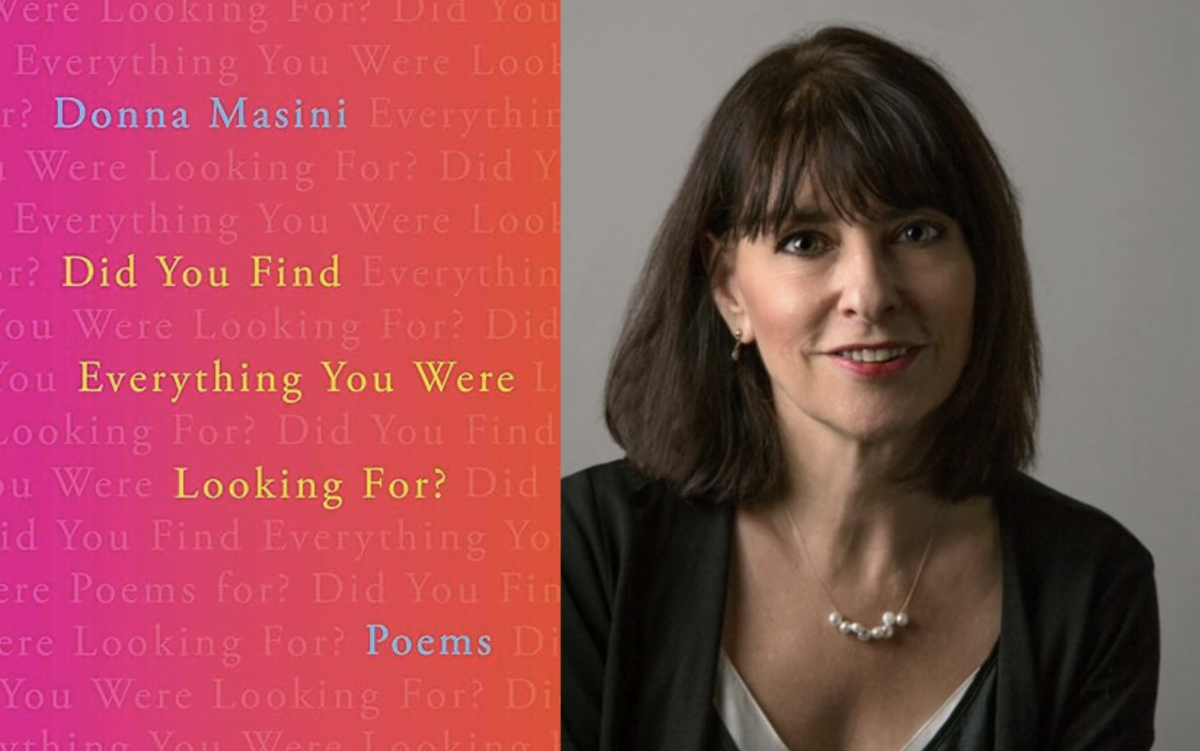
Donna Masini was born in Brooklyn and has always lived in NYC. Her latest collection, Did You Find Everything You Were Looking For? (W.W. Norton), explores our bewildering, increasingly fragmented lives. Her previous books include 4:30 Movie, That Kind of Danger, Turning to Fiction, and About Yvonne, a novel. Adrienne Rich has said: "Donna Masini's poems are on the wavelength of Whitman and Rukeyser but are inimitably her own: urban, sexual, working-class, passionate, marked by great moral intelligence and generosity." Her work has appeared in The New Yorker, The Yale Review, Best American Poetry, Poetry, Paris Review, et al. A recipient of an NEA, a NFYA, and a Pushcart Prize, she is a Professor of English at Hunter College where she teaches in the undergraduate English and MFA Creative Writing programs. She is a Hunter alum.
Nikita Ladd (she/her) is a poet originally from Maryland and currently based in Brooklyn. She is the Special Projects & In School Programs Coordinator at the DreamYard Project in the Bronx and currently a Hunter Poetry MFA second-year student. Her work is out in Rejection Letters, HAD, Pornstar Martini Magazine, Fruitslice, and Discount Guillotine. She won Hunger Mountain Review's Creative Nonfiction Prize in 2021.
Ladd: Today is April 20th. I'm with Donna Masini to talk to her about her new book titled Did You Find Everything You Were Looking For?
Masini: And the answer is... no!! How's that for a first answer?
Ladd: Well, it's good. It's good that we have that out of the way.
Masini: Now we can talk about anything else.
Ladd: It felt fitting to start an interview about this collection by asking you about the first poem in the book, because it sets up the whole collection.
Masini: What are you calling the first poem?
["Meditation" comes on the first numbered page of the book, before the first section in the collection, and "Is There Anything Else I Can Help You With?" is the first poem of the first section of the book, on page 5.]
Ladd: Oh, I'm calling the first poem "Meditation." What are you calling the first poem? Actually, maybe that's the first question.
Masini: It's a proem. I was thinking I wonder if people think that's the first poem, or if the first poem is the first poem. But I also think of it as the first poem, because it sets up the book, right?
Ladd: It does, absolutely. It sets up all these different themes for the book: the movement of the mind, the ticking away of time, and the notebook--which feels so important. I wanted to know about the origin of this poem for you and how it found its way to the front of the collection.
Masini: I had been in Greece, unable to write and trying to meditate to calm myself down. As you can probably tell from the book, I do not have a quiet mind. I keep trying to quiet it, and I had such a frustrating time watching this guy [a meditation teacher] --I was just beside myself. Maybe the next day, I was writing in my journal and then the poem started coming. For me, sometimes, it's the agony of writing, but once I have a little hook, or once I've hooked on a tone, it just keeps coming. I can just play, because it's part me, part not me. I think originally, like some of the poems in this book, this was in third person, but I'm not sure. There's certain parts of myself that I can access in third person that I might not write in first.
Ladd: I noticed there's such a particular energy to these poems that are in third person in the book. I wanted to ask you about that third person feel, but you're saying it unlocks something tonally different for you.
Masini: It does a lot, sometimes. It can become a little fictional. And, I have a test for you. We don't have to do it now. But I want you to tell me which first person poems you think were originally in third?
Ladd: That's gonna be a good Easter egg to go back to. To the point of these different themes that came up in the proem, when I was reading "To the Woman in Window 8 at the DMV," I was struck by the repetitions and associations that both pull the reader from one stanza to the next and also work between different poems in the collection. The line "have you tried meditation" ties to "Meditation," the windows at the end of "Diorama" loop back into this poem, and there's another poem, "Windows" as well. How did the collection become so beautifully latticed like that?
Masini: Oh, I love that word. Latticed. You know, it's so accidental. I was reading this book the other day, because I had to do another interview, and I thought, let me read my book to find out what it's about. Because [they were] asking me, what are the themes? It's surprising how things pop up. But it's your same mind over a certain period of time, so they repeat. Originally, I had a lot of window poems. Only a few of them survived. Some of them I didn't put in the book because they felt either redundant or I felt like I'd hit that note before. But sometimes it would surprise me. Meditation is something I try all the time, and it's so difficult. I'm on a streak right now. It does calm me down, but I'm not somebody who enjoys it, so it will keep popping up. Once you start revising poems, you realize what you've been thinking about, and you revise poems in relation to one another.
Ladd: I like that idea of revising poems towards each other. These poems are living together in your mind before they ever lived together in this specific collection, but you can also do that more intentionally in the revision process.
Masini: That's what I'll be pushing you guys to do in your thesis next year, going through your book and to see which poems beg to be argued against, or which poems are talking to one another. Sometimes, I'll just say throw a bunch of them randomly together and see what conversation they would have.
Ladd: Did you do that with any of the poems in the book? Pair them specifically to talk to each other, or ask them to have a conversation before you knew what the connection might be?
Masini: So originally I had an order, and one of my close readers looked at it and said, "You absolutely cannot start with this poem." Some of those poems now are further toward the back. I had poems talking to one another that broke up. I had to trust that the poems would talk across the book to one another.
Ladd: Well, I can safely say that they did, because so much of my notes while I was reading it was just oh, I remember this from this earlier poem.
Masini: I'm so glad.
Ladd: In class, we talk about "enacting" in poems. I saw so much of that across the whole collection, but even more literally in "The Figure a Poem Makes." What's the connection between what you teach in class, and how that lives in your writing practice?
Masini: It's a goofy poem. I watch figure skating (and gymnastics), and part of me was so jealous that they get to have a coach. But I'd watch and [the skater] would do something, and the announcer would say, "She made that mistake in 2018. Remember how she suffered? Here's a picture of her mother." I was in my kitchen talking out loud, and I'm [narrating]: "Watch her holding her pen." And then I thought, I should write this down. So I started playing with it, and it was fun to enact the technical thing--line break, medial caesura, dactyl--each time I mentioned it. That was fun. I really went back and forth about whether I to put that poem in the book.
Ladd: I'm so glad you did. It has such a life to it, and speaks so much to the ars poetica of writing. It was beautiful to see it embedded in all these poems that are about family and memory, and all these other--
Masini: --losing memories.
Ladd: Right. Losing memory. There's a lot to that.
Masini: I really hate loss. I mean, I'm sure that the people at the next table would say, "Oh, yeah, I really love it. I love loss."
Ladd: That poem is so beautiful. That's the title poem, right? It's "Did You Find Everything You Were Looking For?" that has the list of everything that you've lost?
Masini: Yes--that was another surprise poem. I was walking home from Trader Joe's. I had this guy in my head, the guy at the register, and I sat down and boom, it just came out. Of course everything gets revised, but it's so rare when something just comes out whole. It makes me so happy. And it was prose. That's why I have you guys write in your notebooks, because with prose you can trick yourself into thinking: This isn't a poem. I can relax on the page and say anything. I'm writing this piece right now about notebooks, and I start with how I ask my students to hand in notebooks. For some of you I think: Oh my God, you're finally relaxing. Now you can revise it or compress it a little bit, but just say the thing.
Ladd: I love that you brought that up, because the prose poems really stuck out to me. There's this closeness, but also remove that the third person allows. But they're also about these interactions that you have in the outside world, like at a restaurant or a CVS. What was it about this daily life-ness, these interactions with somebody else, that led you to these poems? Did those come out as prose poems or did you revise any of those into prose?
Masini: Let me first tell you that "Clams" is totally fiction. As soon as I wrote that first sentence, I was off to the races. Of course you use things from your past, but it's all imagined. It's fiction in a way that the others are not. I was laughing when I wrote it. It was light and, one of those things I think about, [how] we move through the world [and] we don't know what things are. How could I not know what a clam is? Do they have legs? That's what I meant about third person, too, because I could have just Googled it, but a more naive part of that speaker could come out, or a more naive part of myself.
Ladd: That also speaks to the interrogation itself being the poem. The note that the poem ends on, which is that she would like to know more about clams, is perfectly naive in this way. The interrogation, the question, is real whether or not it's fiction.
Masini: Yes, the question is real. I love questions, because you don't have to answer them! You can ask anything. And sometimes they just crack me up. I'll get an email from Staples and it'll say: "How are you enjoying your new Post-Its?" I tried so hard to get that into a poem, because it's just the most absurd question. With the other ones: "Did you find everything you were looking for?" and "Is there anything I can help you with?" they become metaphysical almost immediately. I love what questions can do to your imagination.
Ladd: To talk about this collection is to talk about the notebook. You said earlier that it wasn't initially in the collection, so how did you come to include this series titled Notebook?
Masini: I had a collection together, and there was something that wasn't working. I wanted a sense of hybridity. There's that zuihitsu in there, that's different. It comes from my notebooks, but it was written in a different way. The notebook series I pulled together after. I just felt like these things belonged together, I didn't want connectors. I didn't want to explain why. I have many different notebooks: an etymology notebook, a bird notebook, a music notebook, an Italian notebook. The one that I use for writing has free writing, and then maybe notes from a lecture, or [something] somebody says. If I read an article about mushrooms, recipes, everything goes in there. They start to rub off on each other. It's organic. One of the things that I like about collage and juxtaposition is that your reader has more to do. They have to put it together.
Ladd: Well, I feel like that reminds me of what Brenda Shaughnessy said at her reading: It's 50% me and 50% the reader. It's that interaction. So the notebooks in this collection function in a similar way as the poems. They're just in a different form.
Masini: How did you read them? Were you able to read them and think: Oh, I understand why this is a poem?
Ladd: Sometimes it was very clear. I thought well, this is directly linked to the line above it. But with some of them--I don't know if you ever do this with poems--if you unfocus your eyes, you can better see the movement across the whole. Like if I'm at a basketball game and I unfocus my eyes, I can see the movement of every single person in the crowd. The notebook pieces allow for that kind of thing. There's less connective tissue than the poems, but I'm allowing them to wash over me the same way.
Masini: I think that's good, because they're a different kind of poem. Part of the process is in there. But I like the way these juxtaposed pieces hang together. I was thinking, too, about some of the things that Brenda Hillman did in her book, Loose Sugar. She had words, like ash, at the bottom of pages. Things had fallen out of the poems, and belonged there because there were still vestiges of something. Still part of it, but they were no longer in the poem proper. So, those notebook sections, I'll be interested to see how people read them.
Ladd: I really love that description of that book. The idea of what's shaken out of your mind, if a notebook practice is the shaking out of one's mind onto the page. Then, what is shaken out that is important to the collection that you've created? But maybe not played out in the same way a poem is played out.
Masini: I like it as part of the thinking of the book. Part of the process.
To get updates on applying to the Hunter MFA Program, please REGISTER. You'll receive announcements, events news, and more.